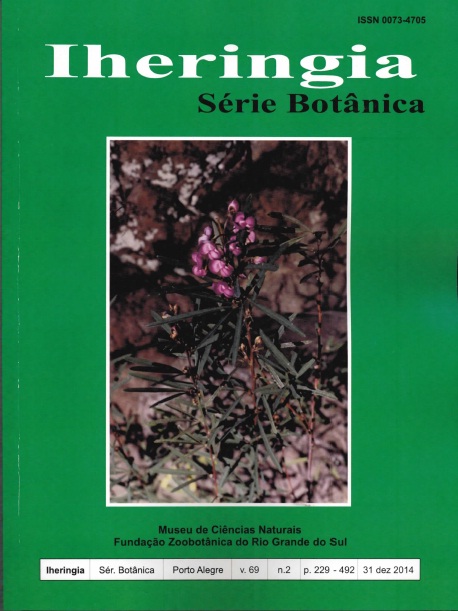
Dyckia racinae L. B. Sm. (Bromeliaceae): descrição morfológica enfatizando as estruturas reprodutivas
Palavras-chave:
antera, espécie endêmica, óvulo, taxonomiaResumo
Este trabalho apresenta uma análise da morfologia externa, interna e, principalmente, da micromorfologia de órgãos reprodutivos, importantes para a caracterização de Dyckia racinae L.B.Sm. A presença de espessamentos parietais em U no endotécio e no conectivo difere de outras espécies de Dyckia Schult. Características dos grãos de pólen e dos óvulos, como micromorfologia da esporoderme e estrutura do apêndice calazal, respectivamente, são similares a outras espécies, sendo úteis para a caracterização do gênero. Preferências por solos pedregosos, além de características das folhas e estrutura da infl orescência, permitem aproximar D. racinae a D. cabrerae Smith & Reitz, nas principais chaves analíticas para o gênero. Considerando-se que Dyckia racinae é endêmica no Rio Grande do Sul, e que a descrição original da espécie foi proposta com base em um único indivíduo em cultivo, entende-se que as características descritas no presente estudo, com base em indivíduos analisados em seu ambiente natural, fi guram como importantes contribuições botânicas.
Downloads
Referências
Benzing, D.H. 2000. Bromeliaceae: profi le of an adaptive radiation. Cambridge University Press, Cambridge. 690 p.
Brown, G.K. & Gilmartin, A.J. 1989. Stigma types in Bromeliaceae – a systematic survey. Systematic Botany 14(1): 110-132.
Brown, G.K. & Gilmartin, A.J. 1984. Stigma structure and variation in Bromeliaceae – neglected taxonomic characters. Brittonia 36(4): 364-374.
Brown, G.K. & Terry, R.G. 1992. Petal appendages in Bromeliaceae. American Journal of Botany 79(9):1051-1071.
Conceição, S.P., De Toni, K.L.G. & Costa, C.G. 2007. Particularidades do nucelo de Dyckia pseudococcinea L. B. Smith (Bromeliaceae). Revista Brasileira de Biociências 5: 846-848.
Endress, P.K. 2011. Angiosperm ovules: diversity, development, evolution. Annals of Botany 107: 1465- 1489.
Endress, P.K. 2005. Links between embryology and evolutionary fl oral morphology. Current Science 89: 749-754.
Fagundes, N.F. & Mariath, J.E.A. 2014. Ovule ontogeny in Billbergia nutans in the evolutionary context of Bromeliaceae (Poales). Plant Systematics and Evolution. Disponível em: http://link.springer.com/
article/10.1007/s00606-013-0964-x. Acesso em 12.03.2014.
Fagundes, N.F. & Mariath, J.E.A. 2010. Morphoanatomy and ontogeny of fruit in Bromeliaceae species. Acta Botanica Brasilica 24(3): 765-779.
Feder, N. & O’Brien, T.P. 1968. Plant Microtechnique. Some principles and new methods. American Journal of Botany 55: 123-142.
Forzza, R.C., Costa, A., Siqueira Filho, J.A., Martinelli, G., Monteiro, R.F., Santos-Silva, F., Saraiva, D.P., Paixão-Souza, B., Louzada, R.B. & Versieux, L. 2014. Bromeliaceae. In Lista de Espécies da Flora do Brasil.
Disponível em: http://fl oradobrasil.jbrj.gov.br/jabot/fl oradobrasil/FB34334. Acesso em 06.02.2014.
Freudenstein, J.V., Harris, E.M. & Rasmussen, F.N. 2002. The evolution of anther morphology in orchids: incumbent anthers, superposed pollinia, and the vandoid complex. American Journal of Botany 89(11):1747-1755.
Furness, C.A. & Rudall, P.J. 2001. Pollen and anther characters in monocots systematic. Grana 40(1-2): 17- 25.
Furness, C.A. & Rudall, P.J. 1999. Inaperturate pollen in Monocotyledons. International Journal of Plant Sciences 160(2): 395-414.
Gabriel, B.L. 1982. Biological Electron Microscopy. Van Nostrand Reinhold Company, New York. 264 p.
Gerrits, P.O. & Smid, L. 1983. A new less toxic polymerization system for the embedding of soft tissue in glycol methacrylate and subsequent preparing of serial sections. Journal of Microscopy 132: 81-85.
Gersterberger, P. & Leins, P. 1978. Rasterelekytronenmikroskopische Untersuchungen an Blutenknospen von Physalis philafelphica (Solanaceae) Anwendung einer neuen Präparationsmethode. Berichte Der Deutschen Botanischen Gesellschaft 91: 381-387.
Givnish, T.J., Barfuss, M.H.J., Van Ee, B.V., Riina, R., Schulte, K., Horres, R., Gonsiska, P.A., Jabaily, R.S., Crayn, D.M., Smith, J.A.C., Winter, K., Brown, G.K., Evans, T.M., Holst, B.K., Luther, H., Till, W., Zizka,
G., Berry, P.E. & Sytsma, K.J. 2011. Phylogeny, adaptative radiation, and historical biogeography in Bromeliaceae: Insights from an eight-locus plastid phylogeny. American Journal of Botany 98(5): 872-895.
Johri, B.M., Ambegaokar, K.B. & Srivastava, P.S. 1992. Comparative Embryology of Angiosperms. Springer, Berlin. 1221 p.
Krapp, F., de Barros Pinangé, D.S., Benko-Iseppon, A.M., Leme, E.M., & Weising, K. 2014. Phylogeny and evolution of Dyckia (Bromeliaceae) inferred from chloroplast and nuclear sequences. Plant Systematics and Evolution. Disponível em: http://link.periodicos.capes.gov.br.ez47.periodicos.capes.gov.
br/sfxlcl41?url_ver=Z39.88-2004&url_ctx_fmt=fi/ fmt:kev:mtx:ctx&ctx_enc=info:ofi /. Acesso em 17.07.2014.
Krapp, F. & Weising, K. 2011. Young and successful: phylogeny and evolutionary history of the large genus Dyckia (Bromeliaceae) inferred from chloroplast and nuclear sequence data. In: Biosystematics Berlin
, programme and abstracts. Botanic Garden and Botanical Museum Berlin-Dahlem, Freie Universität Berlin. 21 p.
Lakshmanan, K.K. 1967. Embryological studies in Bromeliaceae. I. Lindmania pendulifl ora (C. H. Wright) Stapf. Proceedings of the Indian Academy of Sciences 65: 49-55.
Leme, E.M.C., Ribeiro, O.B.C. & Miranda, Z.J.G. 2012. New species of Dyckia (Bromeliaceae) from Brazil. Phytotaxa 67: 9-37.
Martinelli, G., Vieira, C.M., Gonzalez, M., Leitman, P., Piratininga, A., Costa, A.F. & Forzza, R.C. 2008. Bromeliaceae da Mata Atlântica Brasileira: lista de espécies, distribuição e conservação. Rodriguésia
(1): 209-258.
McDowell, E.M. & Trump, B.R. 1976. Histological fi xatives for diagnostic light and electron microscopy. Archives of Pathology & Laboratory Medicine 100(8): 405-414.
Mendes, S.P., Costa, C.G. & De Toni, K.L.G. 2012. Androecium development in the bromeliad Dyckia pseudococcinea L.B.Sm. (Pitcairnioideae-Bromeliaceae), an endangered species endemic to
Brazil: implications for conservation. Flora 207: 622-627.
Moreno, J.A. 1961. Clima do Rio Grande do Sul. Secretaria da Agricultura, Divisão de Terras e Colonização, Porto Alegre. 42 p.
O’Brien, T.P. & McCully, M.E. 1981. The Study of Plant Structure. Principles and Selected Methods. Termarcarphi Pty Ltd, Melbourne. 357 p.
Reitz, R. 1983. Bromeliáceas e a malária-bromélia endêmica. Flora Ilustrada Catarinense (Bromeliáceas), p.1-559.
Sajo, M.G., Furness, C.A., Prychid, C.J. & Rudall, P.J. 2005. Microsporogenesis and anther development in Bromeliaceae. Grana 44(2): 65-74.
Sajo, M.G., Prychid, C.J. & Rudall, P.J. 2004a. Structure and development of the ovule in Bromeliaceae. Kew Bulletin 59: 261-267.
Sajo, M.G., Rudall, P.J. & Prychid, C.J. 2004b. Floral anatomy of Bromeliaceae, with particular referenceto the evolution of epigyny and septal nectaries in commelinid monocots. Plant Systematic and Evolution
(3-4): 215-231.
Smith, L.B. 1988. A giant Dyckia mystery (Dyckia racinae). Journal of the Bromeliad Society 38(6): 249.
Smith, L.B. & Downs, R.J. 1974. Pitcairnioideae (Bromeliaceae). Flora Neotropica Monographs 41-658.
Varadarajan, G.S. & Brown, G.K. 1988. Morphological variation of some fl oral features of the subfamily Pitcairnioideae (Bromeliaceae) and their signifi cance in pollination biology. Botanical Gazette 149(1): 82-91.